Best Family Tents for Car Camping: How to Choose
The best family car camping tent for most crews is a 6-person dome or cabin tent with a floor area near 90 to 100 sq ft and enough center height to stand up. Pick a cabin tent for standing room and a dome for faster setup and wind shedding.
On this page (10 sections)
- How much floor area does a family car camping tent need?
- Why does standing height change the whole experience?
- Which tent wins for most families?
- Which tent suits late sleepers and hot campsites?
- When is a cabin tent the better family choice?
- How should you judge weather protection?
- What else matters when you load the car?
- How do you set up a family tent without a fight?
- How do you compare the three family tents?
- What should you skip when buying?
The best family car camping tent for most crews is a 6-person tent with a floor area near 90 to 100 sq ft and enough center height to stand up. A dome tent is the safer default for a first family shelter, and a cabin tent wins when standing room matters most.
That answer assumes you drive to the site and sleep on airbeds. Car camping means weight and packed size matter far less than they would on a backpacking trip, so you can spend those pounds on space and headroom.
The three tents below cover the main family needs. Read on for how to match floor area, height, weather protection and setup time to your own crew.
How much floor area does a family car camping tent need?
Plan for about 25 to 30 sq ft of floor per sleeper, plus room for gear. A 6-person tent rated at 90 to 100 sq ft gives a family of four airbed space and a dry corner for bags.
That figure comes from how car campers actually sleep. Most families bring air mattresses, which eat floor area fast.
A queen-size airbed covers about 30 sq ft, so two of them fill 60 sq ft of a 100 sq ft tent before anyone unrolls a sleeping bag.
Sleeping bags on pads are more forgiving. Six bags side by side need far less room than two queens, which is why the same tent can feel roomy for a Scout group and cramped for a family with big beds.
Floor area by group size
| Sleepers | Floor area to aim for | Typical tent |
|---|---|---|
| 2 adults | 40 to 60 sq ft | 4-person |
| 2 adults and 2 kids | 80 to 100 sq ft | 6-person |
| 4 adults on airbeds | 100 sq ft or more | 6-person |
| 2 adults and 4 kids | 120 sq ft or more | 8-person |
Measure your airbeds before you buy. A tent's floor length and width decide what fits, and the sleeping capacity number counts people on thin pads, not beds.
If your group is smaller, our guide to the best 4 person camping tents covers the lighter end of the family range. Pick a 4-person tent when you have two sleepers and want a faster pitch.
Pick a 6-person tent at 90 sq ft or more for a family of four; drop to a 4-person only if you sleep on pads.
Why does standing height change the whole experience?
A center height of 72 to 78 in lets most adults stand to dress, and that one feature does more for family comfort than any other. Crouching to pull on pants at 6 am is the complaint that sends families shopping again.
Height matters more in a family tent because you change clothes, wrangle kids and move bedding around. A tent you can stand in turns a cramped morning into a normal one.
Dome tents taper toward the walls, so the center height applies only along the middle ridge. A dome rated at 6 ft may leave you stooped a foot from the edge.
Cabin tents keep a rectangular roof, so more of the floor has usable headroom.
Check the height against your tallest camper, then think about where people stand. If everyone stands near the door to get dressed, a dome's center height can be enough.
If you walk around the whole interior, a cabin tent suits better.
Our 6 person camping tents roundup compares more models in this size band, including the height differences between domes and cabins.
Dome versus cabin height in practice
The Coleman Sundome 6 reaches 6 ft at its center, which clears most adults in the middle. The UNP 6 Person Cabin Tent lists 78 in under a rectangular roof, so the standing zone runs closer to the walls.
Pick a cabin tent when standing room across the whole floor matters; pick a dome when setup speed and wind shedding matter more.
Which tent wins for most families?
The Coleman Sundome 6 Person Tent is the best pick for most families, because it balances a 100 sq ft floor, a 6 ft center height, a rainfly and a straightforward pitch. Nothing in its design pushes a family into a compromise.
Two queen-size airbeds fit inside the 10 x 10 ft floor with room left for bags. Large windows and a ground vent push warm air up and out, which helps on summer nights when the tent holds four bodies.
Coleman's WeatherTec system uses welded corners and inverted seams to keep water out. The 6 ft center height covers changing clothes and stretching out after a long day.
Setup runs on continuous pole sleeves and Insta-Clip attachments, which Coleman rates at about 10 minutes. The tent packs into its carry bag for storage between trips.
The trade-off is dome geometry. Walls slope inward, so the full 6 ft applies at the middle ridge, not beside the beds.
If you want to stand while sorting gear near the walls, a cabin tent fits better.
Pick the Sundome for a first family car camping tent; choose a cabin if you need standing room at the edges.
Which tent suits late sleepers and hot campsites?
The Coleman Skydome Dark Room Tent is the pick when sunrise wakes the kids too early or a nap in bright daylight never happens. Its Dark Room coating blocks 90% of sunlight and reduces heat inside the tent compared with a comparable Coleman model.
The coating matters at summer campsites where the sun rises before 6 am and the tent heats up by mid-morning. Blocking most of that light helps everyone sleep in, and the reduced heat makes the interior more comfortable during the day.
Setup is the fastest here. Pre-attached poles bring the pitch under 5 minutes, which helps when you arrive after dark with tired kids.
Nearly vertical walls give 20% more headroom than traditional Coleman domes.
The WeatherTec floor uses a tub-like design with welded corners and inverted seams. The frame is tested to withstand winds up to 35 mph, and a wider door makes it easier to move airbeds in and out.
The compromise is size. The floor measures 8 x 8 ft, or 56 sq ft, with a 4 ft 8 in center height.
That fits one queen airbed comfortably and leaves little room for a second, and adults will crouch inside.
Pick the Skydome Dark Room for light sleeping and hot weather; skip it if six people sleep on two airbeds.
When is a cabin tent the better family choice?
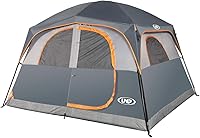
The UNP 6 Person Cabin Tent is the best pick when standing room and ventilation top your list. Its 78 in center height under a rectangular roof means adults stand upright across most of the floor.
The 10 x 9 ft floor holds two air mattresses or six sleeping bags, and the 78 in height gives you room to stand while changing. A large mesh door, five mesh windows and a mesh top let breezes through and give you views from inside.
The frame uses four steel leg poles and a rectangular roof, and the polyester shell carries a polyurethane waterproof coating. A rainfly is included, so the mesh panels stay covered in wet weather.
Setup takes about 5 minutes with two people, and one person can manage it in around 10. The tent weighs about 18 lb and packs into a 24.6 in carry bag.
Those inches are the real trade-off. A 24.6 in bag is long for a small trunk already loaded with coolers and camp chairs, and 18 lb is heavier to carry from the car to the pitch.
The cabin shape also catches more wind than a low dome, so stake it out well.
Pick the UNP cabin for upright changing and airflow; accept the longer packed bag and heavier carry.
How should you judge weather protection?
Look for a full rainfly, a waterproof floor with welded or inverted seams, and a frame rated for wind. Those three features decide whether a wet night turns into a ruined trip.
Family tents live through spring showers, fall drizzle and sudden gusts. The seams are where water usually gets in, so welded corners and inverted seams matter more than a fabric's headline waterproof rating.
A full rainfly covers the mesh that makes a tent breathable. Without one, you choose between ventilation and staying dry.
The Sundome and the UNP cabin both include a rainfly, and the Skydome's rainfly covers its mesh panels too.
Wind is the other half. Dome shapes shed gusts better than tall cabins, and the Skydome's frame is tested to 35 mph.
A cabin tent stands taller and catches more wind, so use every guy line and stake on exposed sites.
Check the floor too. A tub-style floor with raised edges keeps ground water out, and that design appears on the Coleman tents here.
Pick a tent with a full rainfly and a tub floor for wet climates; add extra stakes for any cabin tent on open ground.
What else matters when you load the car?
Packed size and weight decide whether the tent fits your trunk and whether one adult can carry it. These matter less for car camping than for backpacking, but they still shape a family trip.
The Sundome packs into a compact carry bag for easy transport and storage. The UNP cabin's 24.6 x 8.26 x 8.26 in bag is longer, which can crowd a trunk shared with airbeds and a cooler.
The Skydome weighs 11 lb, the lightest of the three.
Think about the walk from car to pitch. A short stroll from the parking lot makes weight a non-issue.
A long haul across a field changes the math, especially if you carry the tent plus bedding in one trip.
Storage between trips matters too. A long cabin bag takes more shelf space in a garage or closet than a dome bag.
Plan the sleeping setup before you pack. Two queen airbeds plus a cooler plus duffels need a floor plan, not just a floor area number.
Sketch where each item goes and check it against the tent's dimensions.
A screen tent or canopy extends the living space outside the sleeping tent. Our guide to the best screen tent for car camping covers the shelters that keep bugs off the picnic table.
Pick a tent whose packed bag fits your trunk with bedding aboard; choose a lighter model if you carry gear far from the car.
How do you set up a family tent without a fight?
Assign each person a job and pitch the tent before the first trip. A dry run in the yard turns a 20-minute argument at dusk into a 5-minute routine.
Setup times vary more than the numbers suggest. The Skydome's pre-attached poles bring it under 5 minutes.
The Sundome runs on continuous pole sleeves and clips, rated at about 10 minutes. The UNP cabin takes about 5 minutes with two people.
Practice once at home, ideally in daylight. Learn which pole goes where, how the rainfly clips on and how the bag packs.
Kids can hand out stakes and hold corners.
On arrival, clear sticks and stones from the pitch, lay the footprint or ground sheet, then stake the corners before inserting poles. Leave the door zipped while you raise the frame so wind doesn't catch it.
Seal the seams on a new tent if the maker recommends it. Re-waterproof the fly and floor each season, and dry the tent fully before storage so mildew doesn't set in.
Our how to choose a camping tent guide covers the broader buying decision, including tent types and materials beyond the family range.
Pick the tent with the setup you can repeat in the dark; practice the pitch at home before the trip.
How do you compare the three family tents?
The Sundome 6 wins for most families on floor area and balance. The Skydome Dark Room wins for light sleepers and hot campsites.
The UNP cabin wins for standing room and ventilation.
| Feature | Sundome 6 | Skydome Dark Room | UNP Cabin |
|---|---|---|---|
| Floor area | 100 sq ft | 56 sq ft | 90 sq ft |
| Center height | 6 ft | 4 ft 8 in | 78 in |
| Setup time | About 10 min | Under 5 min | About 5 min with 2 people |
| Best for | Most families | Late sleepers | Standing room |
| Rainfly | Included | Included | Included |
Use the table as a shortlist, then check the floor plan against your airbeds. The numbers narrow the field; your bedding decides the final pick.
For a wider spread of 6-person models beyond these three, see our 6 person tent comparisons.
Pick the Sundome for a balanced first tent; take the Skydome for dark mornings and the UNP cabin for upright living.
What should you skip when buying?
Skip oversized tents for small groups, tents without a rainfly, and cabins when you camp in strong wind. A tent that's too big wastes floor area and takes longer to pitch.
A family of three rarely needs a 10-person tent. Extra volume means more space to heat with body warmth and more fabric to wrestle in the wind.
A 6-person tent at 90 to 100 sq ft covers most small families.
Skip models without a full rainfly unless you camp only in dry summer weather. You give up the option to close the tent against rain without losing ventilation.
Be wary of tall cabins for exposed, windy sites. A dome sheds gusts better and the Skydome's frame is tested to 35 mph.
Save the cabin for sheltered campsites or still nights.
Finally, skip shopping by sleeping capacity alone. A "6-person" label counts people on thin pads, not airbeds and duffels.
Check floor area and center height instead, and match them to how your family actually sleeps.
The best family car camping tent is the one your crew can pitch, stand in and sleep dry in. For most families that points to the Sundome 6.
Pick the Skydome Dark Room when sleep matters more than floor area, and the UNP cabin when you want to stand up while you change.
Pick by floor area first, then height and weather protection; ignore the sleeping capacity label on its own.
Frequently asked questions
What size tent do I need for a family of four?
A 6-person tent is the usual starting point for a family of four, because it leaves room for airbeds and gear beyond four sleeping bags. A 4-person tent suits four people only if you sleep on pads and pack light.
Is a 6-person tent big enough for two adults and three kids?
Usually yes, if you choose a model with 90 to 100 sq ft of floor area. Check the floor dimensions against your airbeds first, since two queen beds fill about 60 sq ft before you add bags and a cooler.
How tall should a family car camping tent be?
Aim for at least 72 in of center height if you want to stand while dressing. A 78 in cabin height clears most adults; domes around 4 ft 8 in to 6 ft mean crouching near the walls.
Do I need a rainfly on a family tent?
Yes, buy a tent that includes a full rainfly if you camp in spring or fall. A rainfly covers the mesh panels that make the tent breathable, so you keep ventilation without rain coming through.
Can one person set up a family car camping tent?
Some 6-person dome tents go up solo in about 10 minutes, while larger cabin tents are easier with two people. Check the setup time and pole type before you buy if you often camp alone with the kids.