9 Best Sleeping Pads for Car Camping (November 2026)
The best sleeping pads for car camping include the Wakeman Foam Sleeping Pad for Camping (best overall), the CYMULA Memory Foam Camping Mattress Pad (best memory foam feel), and the MOXILS Sleeping Pad (best inflatable for small cars).
On this page (8 sections)
- The best sleeping pads for car camping, tested by specs
- How these car camping sleeping pads compared
- Which sleeping pad fits a car, truck bed or SUV?
- Do you need an insulated pad for car camping?
- How thick should a car camping sleeping pad be?
- Self-inflating, electric pump or plain foam?
- Packing and care for a car camping sleeping pad
- Verdict: the right car camping pad for your setup
The best car camping sleeping pad for most people is the Wakeman Foam Sleeping Pad, because it never goes flat, stays put on a non-slip surface and rolls into a small bundle you can tuck behind a seat. The CYMULA is the pick if you want a soft memory foam surface, and the MOXILS suits anyone with a tight trunk.
Car camping changes what you want from a pad. You don't carry it miles, so weight matters less, and a few extra inches of foam make the night feel far better than a thin backpacking mat.
Our picks cover cots, truck beds, tents and plain car floors. Every option here packs away when you break camp, and the size and thickness notes tell you which jobs each one handles.
Our picks at a glance
-
1

-
2
-
3
- 4
 Check it
Pretyw Ultralight Camping Sleeping Pad with Pillow
Best for tall campers - 5
 Check it
OGERY Self-Inflating Sleeping Pad
Best for side sleepers - 6
 Best for cold nightsCheck it
- 7
 Check it
Easthome Memory Foam Camping Mattress Pad
Best for truck beds and RVs - 8
 Best budget foam padCheck it
- 9
 Check it
LLUAII Self Inflating Sleeping Pad with Electric
Best for easy setup
The best sleeping pads for car camping, tested by specs
The pads here split into two families. Foam pads never deflate and hold warmth, while inflatable pads pack smaller and cushion harder.
Choose foam for a weekend campout where your car does the hauling. Choose an air or hybrid pad when trunk space is tight or when you want to change how firm the surface feels.
Each pick below got its score by weighing thickness, size, weight, pump type and comfort features against what a car camper needs. A foam mat and a 4-inch memory foam mattress both work, but for different people.
Wakeman Foam Sleeping Pad for Camping: Best overall
- 0.75-inch NBR foam
- 72 x 24 in
- Waterproof, non-slip surface
- Carry strap included
A simple foam mat that will not lose air overnight. It works on cots, in tents and on the floor of an RV.
Pros
- Never deflates
- Waterproof and non-slip surface
- Rolls to 24 x 9 in
Cons
- Thin compared with foam mattresses here
- Firm surface for side sleepers
The Wakeman pad is the simplest thing on this list, and that is why it wins. It's 0.75 inches of NBR foam cut to 72 x 24 inches, so it drops straight onto a cot or the floor of an SUV with no pumping and no waiting.
The surface is waterproof and textured, which means it won't slide under you and won't soak up damp ground. The foam traps a layer of warmth between you and a cold floor, and there is no valve or seam that can fail overnight.
At 3 lb it rolls to 24 x 9 inches and carries by a strap. That bundle fits in a footwell or on a shelf in the trunk, which helps when you follow our guide on how to pack a car for camping and want every bag to have a flat home.
Its one real trade-off is thinness. Side sleepers may want more foam under the hip, so compare it with the CYMULA if that's you.
For cots and floor padding, it's hard to beat.
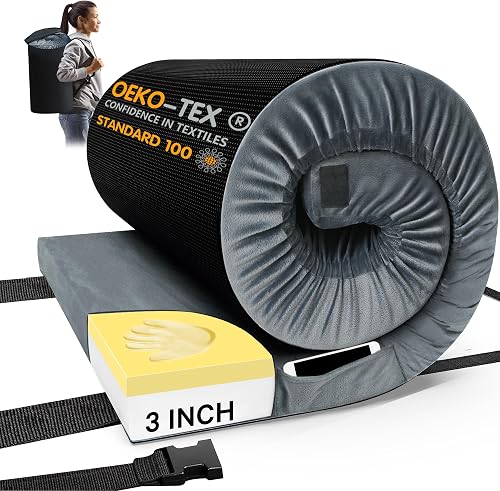
CYMULA Memory Foam Camping Mattress Pad: Best memory foam feel
- 3 inches of memory foam
- OEKO-TEX certified materials
- Waterproof non-slip bottom
- Seven sizes
A soft memory foam pad that shapes to your body. The single size fits a car bed or a narrow tent.
Pros
- Body-conforming memory foam
- OEKO-TEX certified materials
- Rolls into a travel bag
Cons
- Needs 24 to 72 hours to fully expand
- Heavier than an air pad
CYMULA takes the memory foam route: 3 inches of high-density foam that shapes to your body, wrapped in a fleece cover. The bottom is waterproof and non-slip, so it grips a tent floor, a truck bed or a car seat laid flat.
It comes in seven sizes from a small single at 72 x 24 inches up to a queen. That range lets a couple build a full-width bed in a van or a large tent, while a solo camper stays narrow.
The foam arrives vacuum packed and needs about 24 to 72 hours to reach full thickness. Open it well before your trip so it has time to rebound.
Compared with the Wakeman, it's softer and thicker, and it costs you trunk space when rolled. Compared with the air pads here, it avoids the bounce and the nightly pump routine.
It's the pick if a firm foam mat feels too hard.
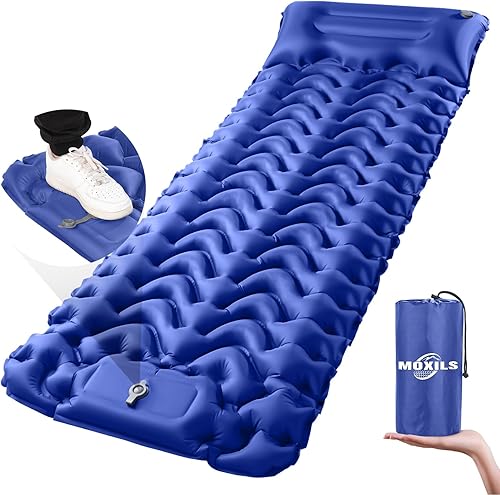
MOXILS Sleeping Pad: Best inflatable for small cars
- Built-in foot pump
- 75 x 25 in inflated
- 1.9 lb
- Side buttons to join two pads
An air pad that inflates in about 20 seconds with a foot pump. It packs small enough for tight trunk space.
Pros
- Inflates with a foot pump
- Light at 1.9 lb
- Two pads join into a double
Cons
- Air-filled surface feels bouncier
- Puncture risk on rough ground
MOXILS solves the small-car problem. It inflates to 75 x 25 inches and 3.5 inches thick, yet weighs 1.9 lb and rolls into a carry bag far smaller than any foam pad here.
The built-in foot pump does the work in about 20 seconds, and a deflation plug empties it fast in the morning. The shell is nylon with a waterproof TPU layer on a 3.5-inch air chamber.
Side buttons let you join two pads into a double, which suits a couple sharing a wide car bed or a big tent. The surface feels firmer and bouncier than foam, and a puncture on gravel is the risk you accept for the small pack size.
If you haul a lot of gear and need the sleeping pad to disappear into a corner, this is the one. If you sleep cold or hate the air-pad feel, a foam pad will serve you better.
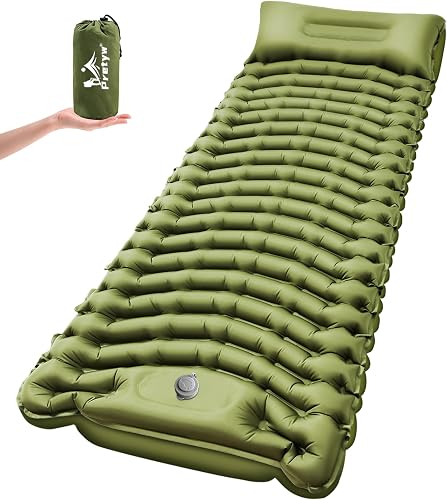
Pretyw Ultralight Camping Sleeping Pad with Pillow: Best for tall campers
- 79 x 27.5 in inflated
- 4 inches thick
- Built-in pillow
- 1.8 lb
A long, wide air pad with a pillow built into the head end. It suits taller sleepers who fit a full-size car bed.
Pros
- 79 in length for tall sleepers
- Built-in pillow
- Packs to a 10 x 4 in bag
Cons
- Air pad needs inflating each night
- Less insulation than a foam pad
Pretyw targets tall campers. It inflates to 79 x 27.5 inches, longer and wider than most pads here, with a full 4 inches of air and a pillow built into the head end.
That length matters when the car bed is a full 78 inches and your feet would otherwise hang off a shorter mat. The built-in pillow saves you packing a separate one, and a foot pump inflates it in about 30 to 60 seconds.
It packs into a 10 x 4 inch bag at 1.8 lb, so it stores like a water bottle and suits tight trunk space. The nylon and TPU shell resists water and wipes clean.
The trade-off is insulation: a single air chamber loses heat faster than foam, so pair it with a blanket underneath on cold nights. Choose it when fit matters more than warmth.
OGERY Self-Inflating Sleeping Pad: Best for side sleepers
- 3 inches of memory foam and air
- 77 x 27 in
- Built-in foot pump
- Non-slip base
A foam-and-air hybrid that cushions shoulders and hips without the bounce of a pure air pad.
Pros
- Foam layer cuts the bouncy feel
- Self-inflates with a foot pump
- Quiet foam fill
Cons
- 6 lb is heavy to carry far
- Needs a firm surface under it
OGERY blends foam and air, and that mix fixes the main complaint about air pads. A 3-inch hybrid core with a memory foam layer spreads your weight instead of bouncing it, so hips and shoulders sink in a little and stay put.
The pad self-inflates once you open the valve, and the foot pump tops it up to your preferred firmness. No mouth blowing is needed.
At 77 x 27 inches it fits a full-size car bed with a little room to spare. The textured base reduces sliding, and the foam fill quiets the crinkling and shifting sounds that air-only pads make.
It weighs 6 lb, so it's a car-camping pad rather than a pack pad. That's the cost of the foam.
For side sleepers who wake up sore on a thin mat, this is the pick.
Wevelel Memory Sleeping Pad: Best for cold nights
- 3.1 inches thick
- 9.5 R-value
- 800 lb support
- 77 x 26.98 in
A thick memory foam pad with a high R-value for cold-weather car camping.
Pros
- R-value of 9.5 for insulation
- Thick 3.1 in foam
- Breathable knit cover
Cons
- Heaviest pad in this group
- Takes longer to inflate and roll up
Wevelel is built for cold trips. Its 9.5 R-value means the foam and fabric slow heat loss from the ground, which is the number to check if you camp in spring or fall.
The pad is 3.1 inches thick and 77 x 26.98 inches, with a 50D stretch knit cover that feels soft against skin and stays quiet in the night. The foam supports up to 800 lb according to the maker.
Setup takes a little longer than a pure self-inflater: open the valves, let the foam expand, close the rear ones and step on the front inlet for about 20 seconds. Deflation uses a two-layer valve that lets air out but not back in.
At 6.59 lb it's the heaviest pad here, so plan storage space. Choose it for cold-weather comfort over packability.
Easthome Memory Foam Camping Mattress Pad: Best for truck beds and RVs
- 4 inches thick
- Dual layer foam
- Waterproof velvet cover
- Built-in pillow
A thick dual-layer pad that keeps you off rocks and cold ground in a truck bed or RV.
Pros
- 4 in of layered foam
- Washable waterproof cover
- Built-in pillow
Cons
- Needs 24 to 72 hours to expand
- Bulky to store
Easthome adds layers. A 3-inch support foam base sits under 1 inch of memory foam for a medium-firm feel that keeps you off rocks and uneven ground.
That structure makes it a strong pick for a truck bed, an RV bunk or a guest bed at home. A waterproof velvet cover protects the foam and zips off for washing, and a built-in pillow means one less thing to pack.
The 72 x 24 inch size is a cot-length pad, and it needs 24 to 72 hours to expand after you open the vacuum pack. Warm weather speeds that up.
Compared with the CYMULA, it's slightly thicker with a firmer base, and it uses the same roll-up storage approach. Both are foam mattresses rather than travel pads, so pick them when the car does the carrying.
TokSay Foam Camping Mattress: Best budget foam pad
- 2.5 inches of 30D foam
- Machine washable cover
- Non-slip base
- 72 x 24 in
A no-inflation foam pad with a removable plush cover that goes in the washing machine.
Pros
- Cover washes in the machine
- Never loses air
- Rolls into a carry bag
Cons
- Recommended for campers under 5 ft 5 in
- Thinner foam than the memory foam picks
TokSay keeps it basic: 2.5 inches of 30D high-density foam that needs no pump, no valve and no morning deflation. You unroll it, sleep and roll it back up.
The standout feature is the removable plush cover, which goes in the washing machine after dusty trips. A non-slip bottom keeps the pad from creeping on tent floors, RV beds and hardwood.
The cot-size 72 x 24 inch pad is recommended for campers under 5 ft 5 in, which is the one spec to check before you buy. Taller sleepers should look at the Pretyw or Wevelel instead.
It's the pick when you want a clean foam pad with easy care and a budget price tier. It's thinner and shorter than the memory foam mattresses here, so it suits kids, shorter campers and occasional guests.
LLUAII Self Inflating Sleeping Pad with Electric: Best for easy setup
- Built-in rechargeable electric pump
- 4 inches thick
- 9.5 R-value
- 77 x 26 in
A thick foam pad that inflates and deflates with a button. The pump makes setup and packing simple.
Pros
- Electric pump inflates in about a minute
- R-value of 9.5
- Compresses to 24 x 12 in
Cons
- Pump needs 2 to 3 hours to charge
- Not meant for backpacking
LLUAII removes the pumping job entirely. A detachable 1200mAh electric pump inflates or deflates the pad with one button in about a minute, and the same pump charges by USB-C from a car or power bank.
The pad itself is 4 inches thick and 77 x 26 inches, with a foam core and a built-in pillow. It has a 9.5 R-value for cold ground and a reversible top with a black side and a gray side for warm and cool weather.
When deflated it compresses to 24 x 12 inches, which is small enough for a trunk corner. The pump needs 2 to 3 hours to charge and runs about seven inflation cycles per charge.
It's not a backpacking pad, so keep it for the car, the RV or the tent. Choose it when setup effort is the thing you most want to avoid.
How these car camping sleeping pads compared
We compared the specified thickness, inflated size, packed size, weight, surface material and inflation method for each pad. Then we matched those numbers to the jobs car campers actually do: cot sleeping, tent sleeping, truck-bed sleeping and guest beds.
The score for each pad weighs those specs against the keyword searcher's main want, which is a comfortable night near the car with easy setup and storage. Pads that hold their shape and warmth scored higher than air-only pads that pack smaller but sleep cold.
| Product | Best for | Thickness | Size | Weight | Our score |
|---|---|---|---|---|---|
| Wakeman Foam Sleeping Pad for Camping | overall | 0.75 in | 72 x 24 in | 3 lb | 9.7 |
| CYMULA Memory Foam Camping Mattress Pad | memory foam feel | 3 in | 72 x 24 in | 9.6 | |
| MOXILS Sleeping Pad | inflatable for small cars | 3.5 in | 75 x 25 in | 1.9 lb | 9.5 |
| Pretyw Ultralight Camping Sleeping Pad with Pillow | tall campers | 4 in | 79 x 27.5 in | 1.8 lb | 8.6 |
| OGERY Self-Inflating Sleeping Pad | side sleepers | 3 in | 77 x 27 in | 6 lb | 8.5 |
| Wevelel Memory Sleeping Pad | cold nights | 3.1 in | 77 x 26.98 in | 6.59 lb | 8.4 |
| Easthome Memory Foam Camping Mattress Pad | truck beds and RVs | 4 in | 72 x 24 in | 8.3 | |
| TokSay Foam Camping Mattress | budget foam pad | 2.5 in | 72 x 24 in | 8.2 | |
| LLUAII Self Inflating Sleeping Pad with Electric | easy setup | 4 in | 77 x 26 in | 8.1 |
Which sleeping pad fits a car, truck bed or SUV?
A pad that matches your sleeping surface will sleep better than a better pad that doesn't fit. Measure the flat space you plan to use before you order.
A standard SUV with the seats folded gives you a space near 72 x 40 inches. A pickup bed is wider but has wheel wells that cut into usable width.
A minivan with the seats out can take a queen.
For a car or SUV with folded seats
A 72 x 24 inch pad is the safe size for one sleeper. The Wakeman, CYMULA and Easthome all match it, and two of the narrow pads side by side can span a wider cargo floor.
Check the door height before you buy a thick pad. A 4-inch foam mattress rolls larger than a 0.75-inch mat and may need to go in through a rear hatch.
For a truck bed
Truck beds take more width, so look at the 27-inch pads such as the OGERY or Pretyw. Add a tarp or mat under the pad to protect it from bed ribs.
A foam pad holds its shape on the ribbed floor better than a thin air pad. If you sleep cold, the Wevelel's 9.5 R-value helps on metal that chills fast.
For a tent next to the car
In a tent you have room for memory foam, so the CYMULA or Easthome gives the softest night. If you want to keep the pack small and the setup fast, the LLUAII with its electric pump does the job in about a minute.
A footprint under the tent protects the pad's base from punctures and damp. That matters more for air pads than foam.
Do you need an insulated pad for car camping?
Yes, if you camp in cool weather or sleep on cold ground. Insulation, shown as an R-value, is the spec that keeps the ground from pulling warmth out of you.
Foam pads insulate by their nature, and NBR foam like the Wakeman's traps air in its cells. Air pads need a stated R-value to promise warmth.
R-value in plain terms
An R-value of 9.5, the figure the Wevelel and LLUAII both give, is high enough for cold nights. Typical foam pads without a stated figure still insulate through their thickness.
If you camp mostly in summer at low elevation, insulation matters less. If you chase fall colors or sleep at altitude, choose the higher number.
Foam versus air warmth
Foam holds warmth and stays put, while a plain air chamber can feel cold under your hips. Hybrid pads such as the OGERY put foam back into the air pad to fix that.
A blanket under any pad adds insulation and grip. That is the cheap fix when the pad you own sleeps cold.
How thick should a car camping sleeping pad be?
A 2 to 4 inch pad balances comfort and pack size for most car campers, while a 0.75-inch foam mat suits cot sleeping or a firm floor.
Thickness is not the same as firmness. A 4-inch air pad can feel harder than a 3-inch memory foam pad because air pushes back instead of shaping around you.
Thin mats for cots and firm sleepers
On a cot, a 0.75 to 1 inch mat is often all you need to soften the canvas. The Wakeman is built for exactly that, and it also works as a topper on an RV mattress.
Firm sleepers who dislike sinking into foam do well with a thin or air-filled surface.
Thick pads for hard floors and side sleepers
If you sleep on the ground or in a truck bed, 3 to 4 inches keeps your hip and shoulder off the hard surface. The CYMULA, Easthome, OGERY and LLUAII all sit in that range.
Side sleepers are the group most likely to feel a thin pad. Ask yourself which way you sleep before you pick thickness.
Self-inflating, electric pump or plain foam?
Plain foam needs no setup at all, self-inflating pads save breath and effort, and electric pumps make setup almost automatic. Pick the one that matches your patience at midnight.
Plain foam pads
Foam pads never leak and never need charging. You unroll them and they are ready.
They also keep working if a valve or pump fails, because there is nothing to fail.
The catch is bulk. A 3-inch memory foam mattress rolls much larger than an air pad, so trunk space decides for some buyers.
Self-inflating and foot-pump pads
These pads open a valve and let foam draw in air, then a foot pump tops up firmness. The OGERY and Wevelel work this way, and the MOXILS and Pretyw use a foot pump alone.
They pack smaller than pure foam while keeping some of the foam feel. Check that the valves close firmly; a partly open valve means a soft pad by morning.
Electric pump pads
An electric pump inflates and deflates on one button, and the LLUAII charges by USB-C. This suits anyone who camps often and wants the fastest setup and pack-down.
You trade a charging job and a heavier pad for the convenience. Charge it before you leave home so it has full power at camp.
Packing and care for a car camping sleeping pad
Packing well makes the pad last and keeps your car from turning into a mess of rolled foam and air bags. A little care after each trip adds years to any pad here.
Packing it in the car
Roll the pad first and let the soft gear fill the gaps around it. Our camping essentials checklist covers what else earns a spot in the car, and a pad bag with a strap makes the stack stay put.
Foam pads can ride flat under a cargo box or strapped behind a seat. Air pads go in a corner bag and take almost no space.
Care for foam and air pads
Wipe foam surfaces with a damp cloth and let them air out in the sun before storing. Wash removable covers by the maker's instructions, and never machine wash the foam itself.
For air pads, keep them away from sharp tools and check the valves for grit. Store them loosely rolled with valves open so air can move and the seams stay relaxed.
Our broader camping gear guide explains which items are worth the space and which ones you can skip on a first car-camping setup.
Verdict: the right car camping pad for your setup
The best car camping sleeping pad for most people is still the Wakeman Foam Sleeping Pad. It's thin, light and simple, and it will never greet you with a flat hiss in the middle of the night.
For a softer night with more foam under your body, choose the CYMULA. For cold-weather camping, the Wevelel's 9.5 R-value earns the spot.
For a tiny trunk or a shared bed, the MOXILS packs down and joins a second pad.
If you want the fastest setup, the LLUAII's electric pump handles it. Measure your car floor, pick the thickness that matches how you sleep, and this list has a pad for it.
If you want to compare comfort in more detail, see our guide to the most comfortable sleeping pad for car camping.
Our top 3 picks at a glance
-
1
-
2
-
3
Frequently asked questions
What thickness sleeping pad works for car camping?
Two to 4 inches of foam or air suits most car campers. A 0.75-inch foam mat works on a cot, while a 3 to 4 inch pad suits sleeping directly on the ground.
Can I use a regular air mattress instead of a sleeping pad?
You can, but air mattresses leak and feel cold without insulation. A foam or foam-and-air pad holds its shape and traps warmth better for overnight car camping.
How do I stop a sleeping pad from sliding in my car or tent?
Look for a textured or non-slip bottom. Most pads here have one, and a fitted sheet or thin blanket under the pad also helps grip a smooth car floor.
Do I need a wide car camping pad for two people?
Yes, or two pads that join. The MOXILS and Pretyw both have side buttons that link two single pads into a wider double bed.
How do I clean and store a car camping sleeping pad?
Air it out fully, then wipe the surface or wash the removable cover. Roll it loosely with the valves open for foam pads, and store it flat or in its bag.


